Tension in Leadership
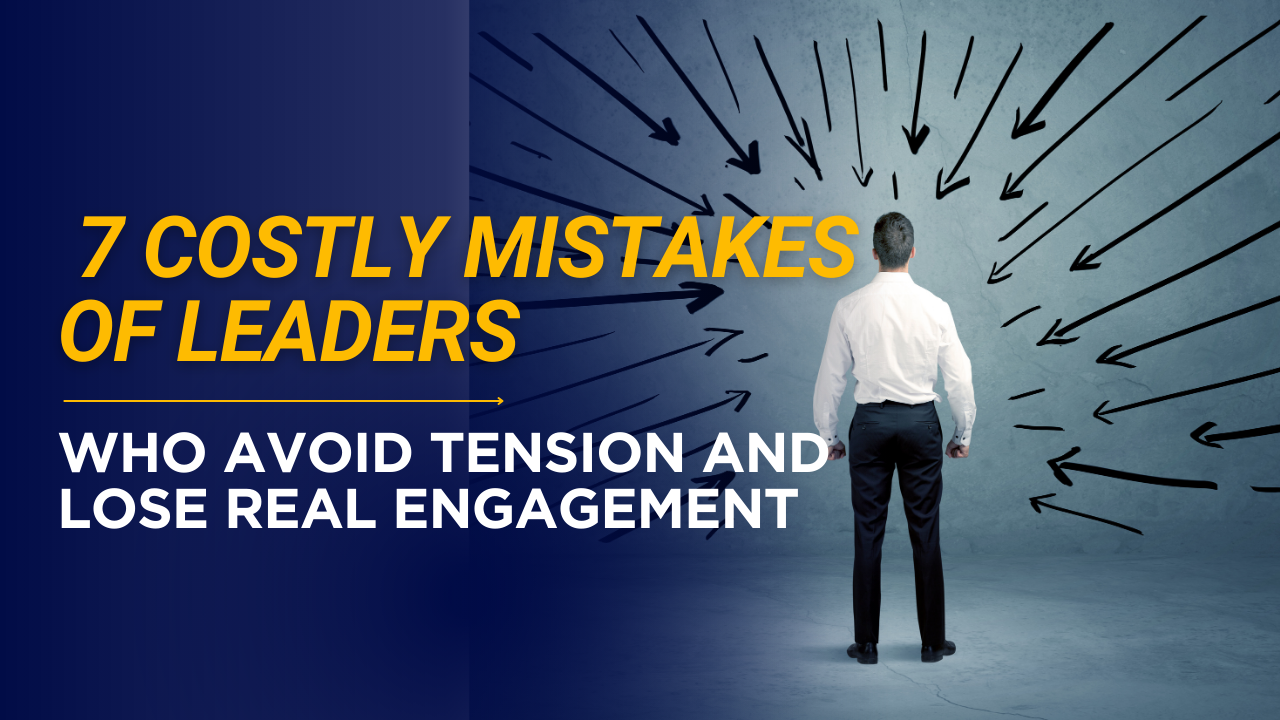
Tension makes most leaders uncomfortable, so they avoid it. They smooth over disagreements, ignore brewing conflicts, and mistake silence for agreement. While this avoidance may appear as a means of maintaining harmony, it actually undermines engagement.
Real engagement requires tension. It’s not the toxic, personal kind of tension, but the productive discomfort that arises from challenging ideas, honest feedback, and difficult conversations. When leaders avoid tension, they create teams that are polite but apathetic, compliant but uncommitted, and present but disengaged.
The leaders who achieve extraordinary results don’t eliminate tension. They learn to navigate it. They understand that tension is where growth happens, where breakthrough ideas emerge, and where genuine trust is built. Avoiding tension might feel safer in the moment, but it creates a slow decline in team energy, innovation, and results.
This guide identifies seven costly mistakes leaders make when they avoid necessary tension. It maps the journey from survival-level leadership through abundance, showing what healthy tension management looks like at each stage and how to progress.
These aren’t theoretical concepts. They’re practical patterns that separate leaders who maintain comfortable mediocrity from those who create exceptional performance through skillful tension navigation.
What Tension Actually Is
Tension is the natural friction that occurs when ideas, interests, or perspectives differ. It’s the productive discomfort that signals important issues need addressing. Far from being a problem to eliminate, tension is the space where growth, innovation, and honesty live.
In healthy organizations, tension shows up as spirited debate about strategy, honest feedback about performance, and direct conversations about misaligned expectations. This kind of tension creates energy and forward movement.
Why Leaders Avoid Tension
Most leaders avoid tension because of fear. Fear stems from the fear of conflict, the fear of damaging relationships, and the fear of losing favor. They mistake tension for dysfunction. believing that successful teams always agree. They lack skills to navigate dysfunction. conversations, so avoidance feels safer than engagement.
Past experiences reinforce this pattern. If you’ve seen tension explode into destructive conflict, if you’ve delivered feedback that went badly, if you’ve facilitated a team discussion that became personal and ugly, you learn to avoid tension. The problem is that avoiding tension doesn’t prevent these outcomes. It guarantees them.
The Difference Between Healthy and Toxic Tension
Healthy tension focuses on issues, ideas, and outcomes. It’s direct but not personal. It challenges thinking without attacking character. It creates discomfort in order to achieve clarity and growth. This kind of tension strengthens relationships and improves results.
Toxic tension becomes personal, punitive, or destructive. It attacks people rather than addresses problems. It’s used to dominate rather than collaborate. Ironically, tension avoidance often creates passive-aggressive toxicity that’s worse than direct conflict.
Costly Mistake #1: Mistaking Silence for Agreement
When leaders present ideas and no one objects, they assume everyone agrees. They take lack of objection as consensus. They assume quiet team members are on board. This assumption is a costly leadership error because it misinterprets team tension avoidance as alignment.
People stay silent for many reasons. They might disagree but not feel safe speaking up. They might see problems but believe their input won’t change anything. They might be disengaged and simply not care enough to object. None of these represent agreement.
The hidden cost is enormous. Implementation suffers when people aren’t really aligned. Tension emerges later, when it’s pricier to address. Team members disengage because their perspective doesn’t matter. The work gets done poorly or not at all because there was no real buy-in.
What to do instead? Explicitly invite dissent and contrary perspectives. Create tension by asking, “What are we missing?” or “Who sees this differently?” Distinguish between agreement and absence of disagreement. Please focus on bringing any underlying tension to light rather than suppressing it.
Costly Mistake #2: Avoiding Difficult Feedback Conversations
Leaders who avoid tension convince themselves that performance issues will self-correct. They provide vague, softened feedback that doesn’t land. They wait until annual reviews to address ongoing problems, hoping the issue resolves itself without the difficult conversation.
This avoidance of tension manifests when leaders convince themselves that feedback will harm their relationships. The discomfort with tension makes them postpone necessary conversations indefinitely. “Nice” feels more important than honest, so they stay silent while problems compound.
The real impact is devastating. Poor performers don’t improve because they don’t know there’s a problem. High performers resent the lack of accountability and start questioning their effort. Tension builds across the team when leaders won’t address obvious issues that everyone can see.
The truth is that clear, direct feedback creates less tension than vague hints and avoidance. The relationship strengthens through honest tension but weakens when pretending everything is fine. Embrace the discomfort as service to both the person and the team.
Costly Mistake #3: Smoothing Over Team Conflicts Too Quickly
When team members disagree, tension-avoidant leaders jump to solutions before understanding the real issues. They force compromise that satisfies no one. They shut down tension before it can be productive because their discomfort with seeing team members in conflict overrides their judgment.
Leaders do this because they believe their job is preventing all tension. They lack skills to facilitate healthy disagreement, so they shut it down instead. This premature resolution trap looks like effective conflict management, but it’s actually conflict avoidance.
What is lost is significant. The real issues driving the conflict stay buried. Creative tension that could generate breakthrough ideas never happens. Team members learn to hide disagreements from leadership, so conflicts go underground where they fester and grow more toxic.
Leading through tension means letting productive tension breathe before resolving it. Assist the team in navigating conflict, rather than eliminating it. Create space for disagreement without making it personal. The discomfort you feel as tension plays out is the price of getting to real resolution instead of false harmony.
Costly Mistake #4: Creating False Harmony Through Tension Suppression
Some leaders enforce positivity that feels mandatory. They punish people who raise difficult issues. They value comfort over candor, creating an “everyone passes along” facade that masks serious dysfunction underneath.
When leaders suppress tension this way, conflicts don’t disappear. They go underground. Passive-aggressive behavior replaces direct tension. Team toxicity grows beneath the harmonious surface, often invisible to the leader but obvious to everyone else.
The engagement cost is severe. People disengage because authenticity isn’t safe. Innovation dies because challenging ideas creates tension that’s not allowed. Trust erodes when real issues can’t be discussed. The team becomes a performance of harmony rather than a genuine collaboration.
Building real trust requires making it safe to disagree openly. The model engages with tension rather than avoiding it. Reward people who surface necessary conflicts. The temporary discomfort of honest tension is far less costly than the permanent dysfunction of suppressed conflict.
Costly Mistake #5: Avoiding Strategic Tension Between Competing Priorities
Leaders who avoid tension often refuse to create it through clear prioritization. They say yes to everything, letting teams pursue conflicting goals simultaneously. They avoid the tension of telling people “no,” so they create confusion about what actually matters.
This manifests as resources spread too thin across too many initiatives. Team members become frustrated by lack of clear direction. The tension that should exist at the strategic level instead emerges as operational chaos. Everyone is working diligently, but nothing is working well.
The result is a leadership failure. Avoiding strategic tension creates more damaging tension downstream. Clear priorities require tension because they mean choosing some things over others. Vague priorities avoid tension in the moment but create it everywhere else.
Embracing strategic tension means making difficult choices. Clear “no” decisions prevent diffuse frustration across the organization. Strategic tension focuses energy; avoiding it dissipates energy across too many competing priorities.
Costly Mistake #6: Protecting High Performers From Accountability
The star player exception is one of the most toxic forms of tension avoidance. Leaders avoid tension with top performers who behave badly. They tolerate toxic behavior because of strong results. They create different rules for different people because confronting the high performer feels too risky.
The team tension that such behavior creates is worse than the tension avoided. Resentment builds among those held to higher standards. Culture erodes when behavior doesn’t match stated values. Successful people leave rather than navigate the tension of working with protected toxic performers.
Leaders make this mistake because fear of losing the high performer creates tension avoidance. Short-term results feel more urgent than long-term culture. The discomfort of having difficult conversations about behavior seems larger than the discomfort of not having them.
The reality is opposite. Holding everyone accountable creates clarity. Confronting stars creates less tension. Real engagement requires consistent standards, which means embracing the tension of accountability at every level.
Costly Mistake #7: Confusing Consensus With Decision-Making
Some leaders seek everyone’s agreement before deciding anything. They avoid the tension of making calls others might disagree with. They let discussions continue until all tension dissolves, which often means forever.
This endless meeting trap costs speed, momentum, and respect. Slow decisions in fast-moving environments mean missed opportunities. Team frustration with indecisive leadership builds.
The tension around indecision exceeds the tension around clear decisions, but the leader can’t see these effects because they’re focused on avoiding the wrong kind of tension.
The leadership clarity missing here is fundamental. Leaders own decisions; they don’t need everyone to agree. Avoiding decision tension creates execution tension. Clear decisions create temporary tension; unclear ones create permanent tension.
Decisive leadership with tension means seeking input, making decisions, and owning them. Create tension through clarity rather than avoid tension through ambiguity. Team engagement actually increases when decisions happen, even imperfect ones, because forward movement creates energy.
The 4 Stages of Tension Navigation: From Survival to Abundance
Practical Steps to Navigate Tension at Each Stage
Stage 1: Survival (Tension Avoidance)
At the survival stage, all tension feels threatening. Every conflict is avoided at any cost. Peacekeeping is prioritized over truth-telling because the leader’s nervous system perceives all tension as danger.
Behaviors include smoothing over every disagreement immediately, never delivering difficult feedback, and hoping problems will resolve themselves. Leaders are present due to past trauma from conflicts that went awry, a lack of skills to address tension productively, or being in survival mode, where retaining their position feels like maintaining peace.
The reality is that tension avoidance creates worse tension later. Team engagement suffers despite the “nice” environment. Leadership credibility erodes through constant conflict dodging.
Stage 2: Stability (Inconsistent Tension Management)
At stability, some tension is addressed, but most is avoided. Leaders handle tension only when it’s unavoidable. Discomfort still dominates their approach, but they’re beginning to notice the cost of complete avoidance.
Behaviors include addressing obvious conflicts while ignoring subtle ones, providing feedback but softening it excessively, and creating some accountability but not consistently. Basic stability allows considering tension differently, though leaders still see it as negative rather than neutral or productive.
What’s needed is skills development for navigating difficult conversations, reframing tension as necessary rather than problematic, and practice engaging with small tensions before large ones.
Stage 3: Success (Strategic Tension Navigation)
At success, tension is viewed as a tool for growth and clarity. Leaders deliberately create productive tension. They skillfully facilitate team conflicts rather than suppress them.
Behaviors include regularly handling difficult conversations with competence, inviting dissent and contrary perspectives, and holding people accountable through direct tension. The breakthrough happens when tension becomes opportunity rather than threat.
Team engagement increases through honest interaction. Addressing real issues improves results.
What sustains this level is developed skills in conflict navigation, a team culture that values candor over comfort, and consistent modeling of tension engagement by leadership.
Stage 4: Abundance (Using Tension as a Leadership Tool)
In abundance, leaders demonstrate mastery over tension creation and resolution. They use tension strategically to drive performance. They build cultures where healthy tension is normalized and expected.
Behaviors include creating necessary tension proactively, teaching others to navigate stress skillfully, and distinguishing productive from destructive tension instantly.
This enables exceptional results through tension mastery, teams that engage authentically rather than superficially, and leadership that transforms organizations through the skillful use of tension.
The reality is that rapid innovation happens through intellectual tension. Deep trust forms through emotional honesty. Sustained high performance requires continuous productive tension.
Moving From Survival to Stability
Start with one small tension you’ve been avoiding. Have one difficult feedback conversation this week. Notice when you’re smoothing over tension automatically and pause instead of rushing to resolution.
Build tension skills by learning basic frameworks for difficult conversations. Practice staying in discomfort instead of rushing to resolution. Learn to separate the person from the problem during conflicts.
Shift your mindset to understand that tension isn’t failure; avoidance is. Short-term discomfort prevents long-term damage. Your job as a leader includes navigating tension, not eliminating it.
Moving From Stability to Success
Proactively create tension by inviting dissent in meetings. Please provide feedback in a clear and direct manner, without softening it. Please address any team conflicts that may have been overlooked.
Build tension competency by facilitating disagreements rather than shutting them down. Practice holding space for tension without rescuing people from discomfort. Develop language for productive conflict that focuses on issues, not people.
Implement systematic changes by incorporating tension navigation into the team’s norms. Create regular opportunities for constructive tension through structured debate or feedback sessions. Model engaging with tension consistently, not just occasionally.
Moving From Success to Abundance
Use tension strategically to drive performance. Build systems that surface tension early, before it becomes a crisis. Teach others to navigate tension skillfully so the capability multiplies across the organization.
Develop advanced tension mastery by knowing when to create tension and when to resolve it. Calibrate tension levels for maximum productivity. Learn to transform toxic tension into productive tension through skilled intervention.
Integrate these skills into culture by making healthy tension a competitive advantage.
Build a reputation as a place where honesty is safe and valued. Create a leadership pipeline that is skilled in navigating tension, ensuring that this capability continues beyond your tenure.
The Leadership Choice About Tension
Tension isn’t optional in leadership. You either navigate it skillfully or avoid it destructively. The seven mistakes in this guide show what happens when leaders choose comfort over candor, harmony over honesty, and peace-keeping over truth-telling.
The stages from survival to abundance aren’t about eliminating tension. These practices focus on transforming your relationship with your body. You should shift your perspective from viewing tension as a threat to viewing it as a tool. You should transition from avoiding necessary conflict to strategically creating productive tension.
Start where you are. If you’re currently avoiding all tension, please consider addressing one small conflict this week. If you manage some tension but not all, please consider identifying which types you are still avoiding and the reasons behind it. If you’re already skilled, focus on teaching others and building a culture where tension serves growth.
Your team is watching how you handle tension. They’re learning whether honesty is safe or silence is required. They’re deciding whether to engage authentically or just comply superficially. The engagement you want requires the tension you’re probably avoiding.
The question isn’t whether tension will exist. It’s whether you’ll lead through it or let it lead you. That choice determines everything about your team’s energy, innovation, and results.