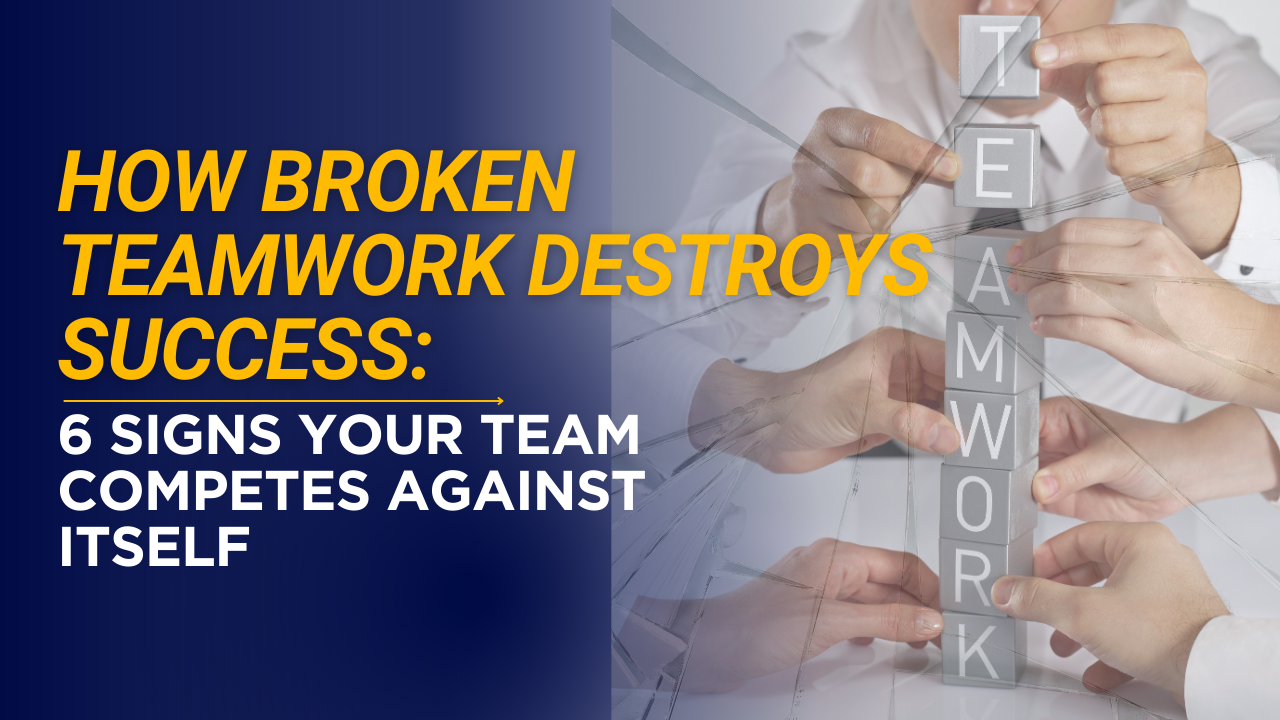
Teamwork Problems: 6 Signs Your Team Competes Against Itself
Teamwork should multiply results, but in most organizations it divides them. The difference between high-performing teams and dysfunctional ones isn’t talent or resources. It’s whether people collaborate or compete against each other.
When teamwork breaks down, the symptoms are obvious to everyone except those creating the problem. Projects stall because information is hoarded. Innovation dies because ideas are stolen rather than built upon. Top performers leave because collaboration feels like a disadvantage.
What’s the worst part? Broken teamwork often masquerades as healthy competition or individual excellence. Leaders celebrate “winners” who succeed by undermining teammates. They reward territorial behavior disguised as ownership. They mistake internal rivalry for motivation.
This article exposes six warning signs that your teamwork has become internal competition. More importantly, it maps the journey from survival-mode dysfunction through stability, growth, and ultimately to abundance, where true teamwork multiplies everyone’s success. Understanding which stage you’re in is the first step toward fixing what’s broken.
Understanding How Teamwork Actually Works
Real teamwork means shared goals that require coordination to achieve. Information flows freely because everyone needs context to contribute. Skills complement rather than compete. Success is measured collectively, and trust forms the foundation of every interaction.
Most organizations claim to value teamwork but reward individual heroics. Performance management systems destroy collaboration by forcing people to compete for limited ratings and rewards. Stack ranking creates artificial scarcity. Bonus pools make your teammates’ success reduce your payout.
The cost of broken teamwork is staggering. Projects take two to three times longer than necessary. Teams duplicate work because they won’t share information. Knowledge walks out the door when people leave. Organizations that don’t penalize collaboration attract top talent. Customers feel dysfunction when internal competition results in poor service.
Sign #1: Information Becomes Currency Instead of Shared Resources.
In dysfunctional teams, people withhold context that would help others succeed. Meetings happen where critical details stay unspoken.
Documentation is deliberately incomplete or hidden. “Need to know” extends far beyond actual security requirements. People use exclusive information to maintain relevance and power.
This phenomenon destroys teamwork because others can’t contribute without the full picture. Decisions get made with incomplete data. Trust erodes when teammates realize information was intentionally withheld. The team becomes dependent on specific individuals, creating vulnerability. As everyone navigates around hidden knowledge, the team’s speed stagnates.
In survival-stage teams, information gets hoarded as protection and leverage. In the stability stage, there is basic transparency that operates on a need-to-know basis. Growth-stage teamwork features active information sharing as the default. Abundance teams make knowledge freely accessible with systems supporting discovery.
Fixing information hoarding starts with documenting decisions and making reasoning visible to the entire team. Create shared knowledge bases and wikis. Reward and recognize information sharing publicly. Make overcommunication the cultural norm rather than the exception.
Sign #2: Credit Is Fought Over Rather Than Shared
Watch how people describe successes. In broken teamwork, individuals position themselves as sole contributors. Teammates get excluded from presentations or communications. Pronouns shift from “we” to “I” when discussing achievements. People actively undermine others’ contributions. Leadership enables such behavior by not investigating who actually did the work.
Credit competition kills collaboration because people stop helping teammates who won’t acknowledge contributions. Collaboration becomes a risk instead of an advantage. Innovation requires vulnerability that credit wars punish. The best ideas stay hidden because sharing means losing ownership. Teamwork becomes performative theater rather than functional reality.
Survival-stage teams operate with zero-sum thinking where credit is scarce. At stability, acknowledgment becomes more consistent but still competitive. Growth teams celebrate collective wins before parsing individual contributions. Abundance-level teamwork multiplies credit through generous attribution.
Building a credit-sharing culture requires leadership modeling generous attribution consistently. Hold team retrospectives highlighting collective contributions. Create recognition systems that reward assists, not just goals. Make collaboration visible and valued in performance reviews.
Sign #3: Success Requires Making Teammates Look Negative
Stack ranking systems force internal competition by design. Limited promotion slots create artificial scarcity. Bonus structures where others’ success reduces your payout mathematically incentivize sabotage. Performance calibration requires comparing teammates. Culture shifts to where looking good matters more than being good.
This process creates a death spiral. High performers optimize for individual metrics at the expense of the team. People avoid helping struggling teammates who might affect their ranking. Innovation stops because failures hurt relatively. standing. Political maneuvering replaces productive work. People, relatively. Collaborative personalities leave or stop collaborating.
Survival-stage teamwork includes active sabotage and undermining to get ahead. Stability brings passive non-cooperation and minimal assistance. Growth features proactive support within clear individual accountability. Abundance creates success and interdependence, where helping others genuinely helps you.
Restructuring for collaborative success means eliminating forced distribution and stack ranking immediately. Add team performance to an individual evaluation with significant weight. Create shared incentives where everyone wins or loses together. Measure collaboration skills as a core competency in reviews.
Sign #4: Mistakes Get Hidden and Blamed Instead of Fixed
In cover-up cultures, problems escalate because nobody admits them early. When issues surface publicly, finger-pointing begins. Energy goes to blame assignment rather than problem-solving. People protect themselves rather than their outcomes. Fear drives behavior, leading to a focus on avoiding risks rather than achieving results.
Such behavior destroys team performance because people stop taking necessary risks. Small problems become big crises through delay. When teammates disregard each other, trust erodes. Learning stops because mistakes can’t be examined honestly. The best people leave because they refuse to work in constant fear.
Survival-stage teamwork features a blame culture with scapegoating and punishment. Stability acknowledges mistakes but still attaches them to individuals personally. Growth implements blameless retrospectives as standard practice. Abundance treats mistakes as valued learning opportunities for the entire team.
Creating psychological safety for true teamwork starts with leadership admitting mistakes publicly and frequently. Explicitly separate people from problems in every discussion. Reward early problem surfacing and transparency. Focus post-mortems on systems rather than individuals. Celebrate productive failures that taught important lessons. relatively.
Sign #5: Silos Form and Defend Their Territory Aggressively.
Territorial behavior disrupts teamwork across organizational boundaries, as teams refuse to share resources or expertise. refuse to share resources or expertise. “That’s not my job” becomes the default response to requests. Functions protect headcount and budget at the mission’s expense. Groups build walls instead of bridges. Everyone optimizes local metrics while overall performance suffers.
Survival-stage organizations feature extreme tribalism with active inter-team conflict. Stability brings separate tribes with minimal interaction or cooperation. Growth enables cross-functional collaboration on specific initiatives. Abundance creates fluid movement and shared purpose across traditional boundaries.
Breaking down silos to restore teamwork requires shared goals and metrics across traditional boundaries. Implement rotation programs and cross-functional projects. Design physical and digital spaces that encourage mixing. Have leadership model collaboration across functions consistently. Eliminate incentives that reward local optimization at enterprise expense.
Sign #6: New Ideas Get Shot Down by Threatened Colleagues
In dysfunctional teamwork, ideas get rejected not on merit but because of who suggested them. “Not invented here” syndrome runs rampant. Experienced members dismiss newer teammates automatically.
Resistance to change is driven by a desire to protect the current status and power. Creativity is punished through mockery or immediate dismissal.
Survival-stage teams uncover new ideas actively dangerous to those invested in the status quo. Stability considers ideas cautiously but rarely implements them. Growth encourages innovation with structured experimentation. Abundance establishes continuous improvement and idea generation as norms for the team.
Fostering innovative teamwork requires psychological safety that allows negative ideas on the path to good ones. Use structured brainstorming where all ideas get genuine consideration. Run small experiments and pilots to reduce the risk of change.
Recognize trying new approaches regardless of outcome. Have senior people champion and build on junior people’s ideas.
The Four Stages of Team Development
Most teams start in survival mode, characterized by open conflict, sabotage, and a complete lack of trust. Daily experiences involve exhausting politics and constant defensiveness. Business results are poor, turnover is high, and reputation suffers. A leadership vacuum or active toxicity traps teams in this situation. Breaking points include mass exodus or intervention from above.
The stability stage brings functional but not collaborative teamwork. People coexist peacefully without genuine collaboration. Daily experience resembles parallel play, where everyone does their piece without integration.
The business impact is adequate, but there is a significant missed opportunity for synergy. This stage lacks both active problems and magic.
The growth stage develops genuine teamwork with increasing trust and real collaboration on complex work. Daily experience becomes energizing with collective problem-solving. Results exceed the sum of individual contributions.
People actively help and build on each other’s work. We can leverage momentum in this phase to institutionalize collaboration.
The abundance stage achieves high-performing team excellence with seamless coordination and distributed leadership. Daily experience includes flow states and collective intelligence emerging naturally. Business impact shows exceptional results with apparent ease.
Teamwork quality involves anticipating needs and optimizing complementary strengths. Maintaining excellence requires continuous attention to team health.
Diagnosing Your Team's Current State
An honest assessment starts with hard questions. How freely does information flow across team members? What happens when someone makes a mistake? Do people celebrate teammates’ successes genuinely?
How are decisions made, and who is involved? What’s the quality of conflict and disagreement?
Look past superficial harmony to identify real dysfunction. Use anonymous feedback to surface hidden issues. Review exit interview patterns for teamwork problems. Ask customers and stakeholders how they perceive team function. Compare actual results to potential given your resources and talent.
Most teams function in a state of survival or stability, often missing out on the multiplication effect that genuine teamwork can provide. Acknowledging where you are today is the first step toward progress.
Rebuilding Teamwork at Each Stage
Emergency interventions for teams in the survival stage begin with halting the bleeding. Remove toxic individuals immediately, even high performers. Establish basic psychological safety and ground rules for interaction. Create quick wins that demonstrate collaboration pays off. Have leadership take responsibility and set a new tone. Bring in professional facilitation if conflict is severe.
Transitioning from stability to growth requires introducing collaborative projects with shared accountability. Celebrate team wins prominently and specifically. Train people on giving and receiving feedback constructively. Implement cross-training so people appreciate others’ work. Build social connections beyond work tasks.
Accelerating from growth to abundance involves distributed leadership and rotating facilitation. Adopt advanced collaboration tools and practices. Conduct regular retrospectives focused on continuous team improvement. Take on challenging projects requiring deep coordination. Maintain intentional focus on team health as a practice, not an afterthought.
Sustaining high-performance teamwork means hiring for collaboration and a team-first mindset. Design onboarding that immerses new members in a team in a team-first way. Let’s schedule regular team health check-ins and make any necessary adjustments. Protect against complacency and regression. Evolve teamwork practices as the team grows and changes.
Your Path Forward
Teamwork doesn’t fail because of bad people. It fails because of bad systems, misaligned incentives, and leadership that rewards individual heroics over collective success. The six signs of broken teamwork are symptoms of deeper structural problems in how you measure, reward, and enable collaboration.
Please begin by identifying which sign is most apparent in your team at the moment. Is information being hoarded?
Are people fighting over credit? Do mistakes trigger blame storms? Address that symptom while fixing the underlying system creating it.
Moving from dysfunction to high performance requires an honest diagnosis of where you are today and committed action to progress to the next stage. You can’t skip levels. A survival-stage team can’t jump straight to abundance. But you can move forward deliberately.
True teamwork isn’t about trust falls and team-building exercises. It’s about removing the barriers that make competition rational and creating structures where collaboration becomes the obvious path to success.
Your team’s transformation can start with one honest conversation today about the teamwork you actually have and the teamwork you need to build.