Mediocrity Isn't Harmless: It's A Silent Thief.
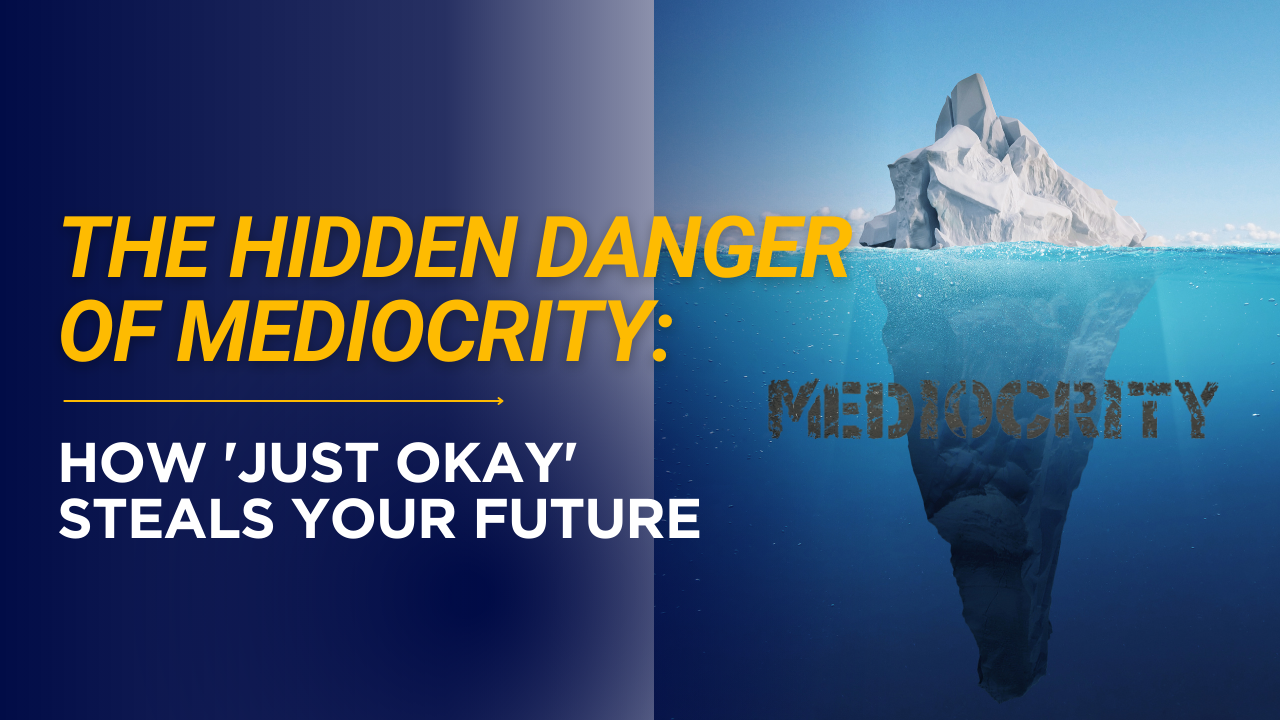
Mediocrity doesn’t announce itself with warning signs or dramatic failures. The comfortable trap of settling for “good enough” gradually erodes your potential while you remain preoccupied with being busy. Unlike obvious problems that demand attention, mediocrity lets you feel productive while going nowhere.
You have moderate success, so change is not critical. You’re just staying exactly where you are, year after year, while opportunity costs compound silently in the background. The danger of mediocrity is that it feels safe. Adequate performance keeps you employed. Acceptable effort maintains relationships. Good enough gets you by.
But “getting by” isn’t neutral. It’s actively stealing your future by consuming the time and energy you could invest in excellence. This article exposes how mediocrity operates at different life stages, from survival mode, where it feels necessary, through stability, where it becomes habit, into growth, where it holds you back, and finally shows what life looks like when you break free into abundance.
What Mediocrity Actually Is
Mediocrity isn’t the same as deliberate moderation or strategic focus. Choosing not to excel at everything is wisdom. Accepting mediocrity in areas that matter to you is surrender. The difference is intention versus resignation.
Mediocrity is a choice, though most people don’t recognize they’re making it. It’s the daily decision to do the minimum required, avoid challenges that would force growth, and settle for “fine” when you could have “excellent.” It masquerades as balance, realism, or contentment, but it’s actually fear wearing a comfortable disguise.
The compound cost of settling for an average is staggering. A mediocre performer earning $50,000 loses more than $25,000 per year compared to an excellent performer in the same role who earns $75,000. Over 20 years, accounting for raises and compound investment returns, that gap exceeds $800,000. Mediocrity in health means declining energy and capacity over decades. Mediocrity in relationships means years passing without genuine connection or growth.
Smart people become trapped in mediocrity for predictable reasons. Comfort zone addiction makes familiar mediocrity feel safer than uncomfortable excellence. Fear of failure masquerades as contentment with current circumstances. Social pressure to fit in keeps people conforming to the average.
Exhaustion from life’s demands leaves no energy for excellence. Without a compelling vision propelling them forward, people tend to default into mediocrity.
The Mediocrity Mindset
Listen to the language patterns that signal mediocrity. “It’s fine” when clearly it’s not. “Good enough” is becoming the default standard for everything. “I don’t have time” for things that actually matter while scrolling for hours daily. “That’s just how it is,” accepting limitations as unchangeable. “At least I’m not comparing myself to those who are more successful.”
Behavioral markers are equally telling. One should only perform the bare minimum necessary and not exceed challenges that would force uncomfortable growth. The focus is on consuming content rather than creating value. Waiting for permission or perfect conditions before starting is a common practice. Instead of innovating, people often copy the actions of others.
Society reinforces mediocrity through collective acceptance. Mediocre people pull others down because excellence makes them uncomfortable. Culture celebrates “phoning it in” and mocks trying too excessively. Social media normalizes low standards by showcasing curated highlights instead of sustained effort. The comfort of collective mediocrity feels safer than the loneliness of pursuing excellence.
Stage 1: Survival Mode
In the survival stage, life is a precarious existence with little room for error. Every day is reactive crisis management. Basic needs consume all energy and attention. There’s no bandwidth for excellence or improvement. Getting through the day is the only goal that feels achievable.
Mediocrity seems acceptable here because any income feels better than none. It requires all your energy to stay afloat. There’s genuinely no energy left for excellence or optimization. Social comparison to others struggling similarly makes mediocre performance feel like victory.
The trap occurs when mediocrity in survival becomes a permanent part of one’s identity. What starts as a temporary necessity becomes an ingrained habit. You begin identifying as “someone who just survives by.” Skills atrophy from lack of challenge. Networks shrink to include only other survival-mode people. Future opportunities close as time passes and you stay stuck.
Breaking out requires one area of excellence despite circumstances. You should dedicate fifteen minutes daily to skill development. Make connections with those who are ahead of you, not just those who are next to you. Mindset shift from victim to strategist. Small wins show that improvement is possible and build evidence that you’re not permanently trapped.
Stage 2: Stability (The Most Dangerous Phase)
Stability-stage mediocrity is characterized by comfortable income and lifestyle. A predictable routine requires minimal effort. There are no major problems or excitement. Performance remains adequate to keep jobs and relationships. You coast on past achievements and existing skills.
This stage is most dangerous because comfort creates complacency. There’s no pain forcing change or growth. You’re competent enough to keep your job but not skilled enough to be promoted. Years pass while you stay in essentially the same place.
Wake-up calls often come too late through layoffs, health crises, or relationship collapses. The mediocrity indicators are clear. You have the same skills and knowledge as five years ago. Income barely keeps pace with inflation. Relationships feel stale but functional. Health declines slowly through neglect. Dreams are often postponed indefinitely as “someday” goals, which everyone understands to mean never.
Escaping requires brutal honesty about your current trajectory. Create artificial urgency through deadlines and public commitments. Invest in skills that increase market value. Surround yourself with people actively pursuing excellence. Set standards higher than the required minimum, not because anyone demands it but because you refuse to settle.
Stage 3: Growth (Actively Fighting Mediocrity)
The growth stage looks like deliberate skill development and continuous learning. Stretching beyond current capacity can cause discomfort. Results are improving measurably over time. We are saying no to excellent opportunities in order to focus on outstanding ones. Investment in future capacity rather than consumption today.
The mediocrity pullback effect is strong here. Social pressure comes from people you’re leaving behind. Self-doubt surfaces when growth feels uncomfortable. Temptation to retreat to comfort zones intensifies when challenges appear. Imposter syndrome kicks in as you enter new levels. Fatigue from sustained effort above a mediocre baseline makes quitting attractive.
Maintaining growth momentum requires systems that make excellence automatic. Accountability structures prevent backsliding. Celebrating progress reinforces new identity. Surrounding yourself with growth-minded people provides social proof that excellence is normal. Regular reality checks distinguish actual progress from comfortable perception.
Common mistakes include expecting linear progress and quitting at inevitable plateaus. Spreading effort too thin across too many areas is a common mistake. One common mistake is comparing the beginning of your journey to the middle of someone else’s. There is a tendency to overlook the basics in pursuit of more sophisticated methods. Burnout occurs when one engages in unsustainable intensity that cannot be maintained over the long term.
Stage 4: Abundance (Excellence as Default)
At the abundance level, excellence feels natural rather than forced. Compound advantages from years of growth create momentum. Opportunities come to you instead of requiring constant pursuit. You have the capacity to help others while maintaining your own high standards. Focus shifts to legacy and impact beyond personal gain.
Mediocrity still threatens at top levels through complacency after achieving initial success. Reliance on reputation, rather than current performance, becomes the norm. Delegating so much, you lose your competitive edge. Success breeds comfort; it breeds mediocrity. Past achievements are blocking future growth because you’re living off old wins.
Sustaining excellence requires continuous learning and skill sharpening. Regular reinvention and evolution are necessary to adapt to changing markets and circumstances. You should surround yourself with people who challenge you rather than flatter you. Discovering new challenges to conquer after conquering previous ones is crucial. It is crucial to vividly recall the consequences of reverting to mediocrity.
The Real-World Cost of Mediocrity
Career mediocrity creates an income gap that compounds devastatingly over time. Average performers earn 30–50% less than top performers in the same roles. Mediocre workers face layoff vulnerability and lack career security. Opportunities stay limited, and advancement stagnates. There’s no leverage or negotiating power. You become trapped in the “replaceable” category.
Relationship mediocrity shows up as marriages that feel “fine” but lack vitality and growth. Friendships are maintained out of obligation rather than genuine joy. Mediocre parenting, which fails to develop children’s full potential, can have a generational impact. Professional networks frequently fail to offer genuine value when required. Low-effort attempts at connection lead to isolation.
Health mediocrity refers to a state of having only adequate health, which limits daily capacity. Energy levels are just adequate for basic functioning. Preventable declines are accepted as inevitable aging. Quality of life is steadily decreasing year by year. A medical crisis serves as a wake-up call, but it arrives decades too late.
Financial mediocrity looks like living paycheck to paycheck at every income level. Despite earning an adequate income, there is no opportunity to build wealth. Retirement is becoming unaffordable or barely sustainable. Financial stress persists, despite earning decent money. There is a complete lack of options and flexibility in the later years of life when they are needed the most.
Breaking Free: The Anti-Mediocrity Action Plan
Start with an honest assessment of current mediocrity across life areas: career, health, relationships, finances, and personal growth. Compare your trajectory to your potential, not to others around you. Identify where mediocrity has become acceptable through habit or exhaustion. Calculate the real cost of staying where you are for another five or ten years. Acknowledge uncomfortable truths without judgment or excuse-making.
You can’t be excellent at everything simultaneously. Choose your excellence focus areas strategically. Practice deliberate mediocrity in some domains to excel in priorities that matter most. Apply 80/20 thinking to identify what matters most in your life right now. Sequence excellence across different domains over time rather than trying to correct everything at once.
Build anti-mediocrity systems with clear standards and metrics for excellence in each focus area. Create accountability structures and tracking mechanisms. Design your environment to make excellence easier than mediocrity. Develop habits and routines supporting high performance. Schedule regular reviews and course corrections.
Launch a 30-day anti-mediocrity challenge. Week one: audit and assess current mediocrity honestly. Week two: choose one area for excellence focus. Week three: implement systems and raise standards concretely. Week four: track results and adjust the approach based on data. Beyond 30 days: expand excellence to additional areas progressively.
The Psychology of Rejecting Mediocrity
Your identity determines your standards. How you see yourself dictates what you’ll accept. The stories you tell about who you are and what’s possible become self-fulfilling prophecies. Breaking identity attachments to mediocre performance requires building evidence for a new excellence-based identity. Language shifts reflect and reinforce higher standards.
Your excellence will make mediocre people uncomfortable. Expect criticism disguised as concern. “You’ve changed,” and “You think you’re better than us” are common responses. Find and build community around excellence rather than mediocrity. Set boundaries with people invested in keeping you mediocre. Accept the temporary loneliness of leaving the crowd before finding your tribe.
Sustain motivation through discipline, not feelings. Create a compelling vision that pulls you forward even when motivation fades. Track progress, showing concrete improvements over time. Celebrate and acknowledge growth explicitly. Connect to a purpose beyond yourself that makes sustained effort meaningful.
Your Future Depends on Today’s Choice
Mediocrity is the silent thief that steals your future one “good enough” at a time. It’s not dramatic or obvious, which makes it dangerous. You can coast on adequate performance for years before realizing what you’ve lost.
The path from survival to abundance requires rejecting mediocrity at every stage. In survival, refuse to accept that struggling is your permanent identity. In stability, resist the comfortable trap of coasting. In growth, push through the pullback when excellence feels challenging. In abundance, avoid complacency that breeds regression.
Excellence isn’t about perfection or being the best at everything. It’s about choosing specific areas where you refuse to settle and committing to continuous improvement. The compound effect of excellence versus mediocrity over time is staggering.
Your future self is counting on decisions you make today. Are you willing to accept “just okay,” or would you prefer to strive for more? The cost of mediocrity is too high to accept. Your future is too valuable to steal from yourself.