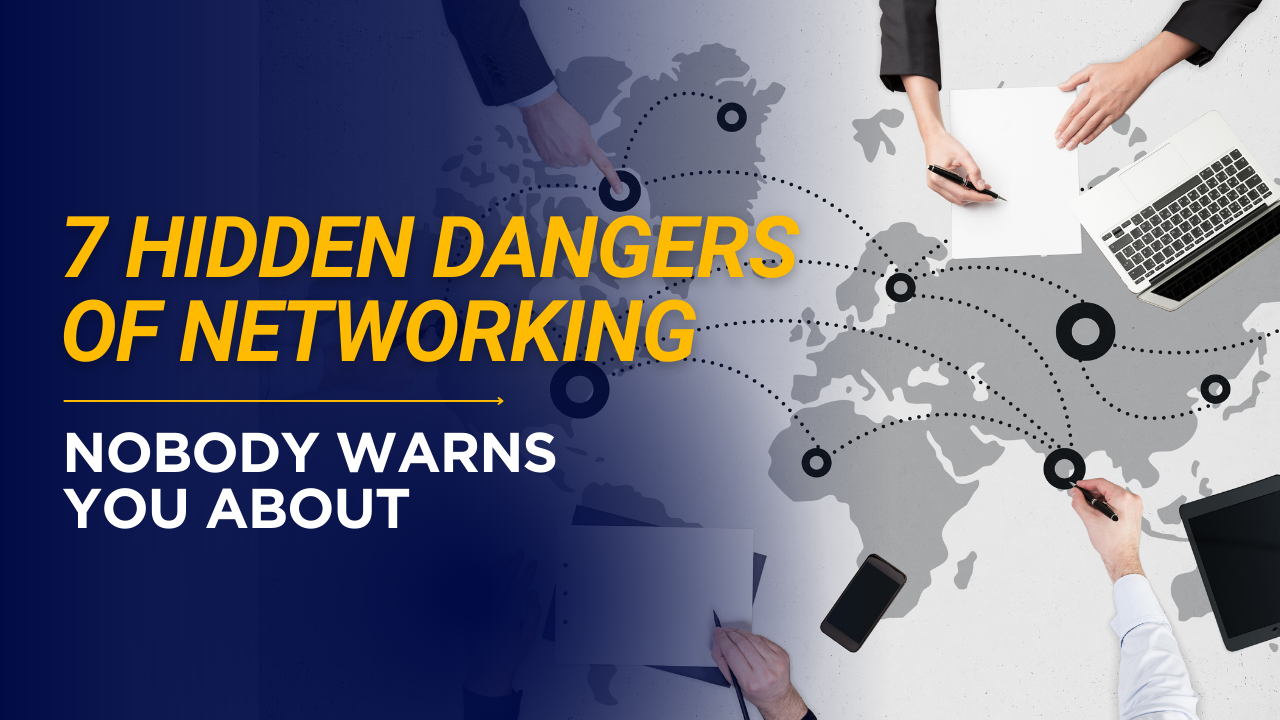
Networking Hidden Dangers: Nobody Warns You
Networking has become a career necessity, but nobody talks about its dark side. While everyone pushes you to attend more events, collect more contacts, and expand your circle, few acknowledge that networking can actually harm your career, drain your energy, and damage your authenticity.
The truth is that networking at the wrong stage of your development or in the wrong way creates more problems than opportunities. From survival mode, where networking feels impossible, to abundance, where it becomes effortless, your approach to building connections must evolve.
Most networking advice assumes everyone starts from the same place and needs the same strategies, which leads to burnout, wasted time, and hollow relationships. This article breaks down the seven hidden dangers of networking that professionals rarely discuss, organized by developmental stages from survival to abundance.
Understanding these pitfalls and knowing which apply to your current situation will save you years of frustration and help you build genuine connections that actually matter.
Understanding Networking Across Developmental Stages
Why One-Size-Fits- All: Networking Advice Fails
Traditional networking advice treats everyone the same: attend events, follow up within 24 hours, offer value first, and maintain regular contact. But this generic approach ignores a critical truth. Your capacity for networking and the type of connections you need change dramatically based on your developmental stage.
Someone struggling with basic survival needs can’t network the same way as someone operating from abundance. Trying to force networking behaviors that don’t match your current reality leads to the hidden dangers we’ll explore. The five stages (survival, security, belonging, achievement, and abundance) each present unique networking challenges and opportunities. Recognizing your stage helps you avoid common pitfalls and focus on connections that actually serve your growth.
The Networking Paradox Nobody Mentions.
The irony is that you need networking most when you can’t do it, and you’re best at it when you need it least. People in survival mode desperately need connections but have nothing to offer and no energy to give. People in abundance naturally attract opportunities without effort.
This creates a cruel cycle where those who need help most struggle to access it, while those with plenty receive more. Understanding this paradox is essential because it explains why networking feels so different at various life stages and why the same strategies produce wildly different results.
Survival Stage: When Networking Becomes Exploitation
Danger 1: Predatory Networking Disguised as Opportunity
At the survival stage, you’re vulnerable to the first hidden danger: predatory networking. When you’re desperate for income, stability, or basic opportunities, certain people sense that vulnerability and exploit it. Multi-level marketing schemes, pay-to-play networking groups, expensive masterminds promising connections, and “mentors” who extract free labor all target people in survival mode.
These predators position themselves as networking opportunities when they’re actually extraction mechanisms.
The danger intensifies because survival-stage networking often requires you to say yes to everything since you don’t know which connection might lead to stability. This makes it nearly impossible to distinguish genuine opportunities from exploitative ones.
You attend events where everyone is selling something. You join groups that charge monthly fees you can’t afford. You work for free for people who promise exposure or introductions that never materialize.
Before engaging in any networking opportunity that requires payment or significant time investment, ask three questions. Does this person have a track record of actually helping people at my level? Are they asking me to pay or work before providing any value? Do I feel pressured to decide immediately? If the answers raise concerns, walk away regardless of how promising it sounds.
Danger 2: Energy Depletion When You Have None to Spare
The second danger hits hardest at the survival stage: networking depletes the limited energy you desperately need for actual survival tasks.
Every networking event, coffee meeting, and follow-up email consumes mental and emotional resources. When you’re barely keeping your head above water, spending three hours at a networking event plus travel time can mean bills don’t get paid, job applications don’t get submitted, or essential rest doesn’t happen.
Traditional networking advice ignores this reality. It assumes you have surplus energy to invest in relationship building. But at the survival stage, there is no surplus.
Every hour spent networking is an hour not spent on immediate income generation or crisis management.
Limit networking to one focused activity per month. Choose events or connections most likely to lead directly to paid work or immediate stability. Skip general networking in favor of specific, transactional opportunities. This isn’t the stage for building long-term relationships. Focus on connections that provide immediate, tangible returns. Protect your energy like the scarce resource it is.
Security Stage: The False Safety of Weak Networks
Danger is building a network that reinforces limitations.
At the security stage, you have achieved basic stability and are beginning to build a professional network. Here’s the third hidden danger: you unconsciously create a network that keeps you stuck. People at the security stage tend to network primarily with others at the same level, creating echo chambers that reinforce limiting beliefs and risk-averse thinking.
This happens because security-focused networking prioritizes comfort and familiarity over growth. You connect with people who think like you, work in similar roles, and share your cautious worldview. Everyone agrees that taking risks is dangerous, that the system is rigged, and that staying safe is smart. This network feels supportive but actually reinforces the mentality keeping you from advancing.
The danger is subtle because these relationships feel genuine and positive. Your network validates your choices and provides emotional support. But validation without challenge equals stagnation. When everyone in your circle operates from scarcity and fear, you never encounter the mindsets and opportunities that exist at higher levels.
Intentionally connect with 2-3 people who are one stage ahead. Join groups or communities where you’re the least accomplished person in the room. Seek perspectives that challenge your security-focused thinking. This discomfort is what growth actually feels like.
Danger 4: Mistaking Networking for Relationship Building
The fourth danger emerges as you transition from security to belonging: confusing networking transactions with genuine relationships. At the security stage, networking often means collecting contacts, attending events for security, and maintaining superficial connections through occasional check-ins. This transactional approach creates a large network of weak ties that feel hollow.
The issue becomes more pronounced when you recognize that your extensive network may not offer meaningful support, honest feedback, or genuine opportunities. You have 500 LinkedIn connections but nobody you can call when facing a real challenge. You’ve attended dozens of events but formed no lasting friendships.
This danger wastes years because you’re doing what networking experts recommend (expanding your network, staying visible, following up) without building the depth required for real advancement. Weak ties have value, but a network composed entirely of weak ties leaves you isolated despite appearing well-connected.
Shift focus from quantity to quality.
Choose five relationships to deepen rather than five events to attend. Have real conversations instead of exchanging business cards. Ask people about their actual challenges, not just their professional highlights. Share your own struggles, not just successes. This vulnerability transforms networking from transaction to relationship.
Belonging Stage: When Your Network Limits Your Identity
Danger 5: Identity Capture Through Professional Communities
At the belonging stage, you’ve found your people and become part of professional communities that matter to you. The fifth hidden danger arrives here: your network begins to define and limit your identity. You become “the marketing person” or “the startup guy” or whatever label your community assigns you. Your network’s expectations about who you are and what you do start constraining your evolution.
This danger is particularly insidious because belonging feels so good after earlier stages of isolation or transactional networking. You finally have a professional home, people who understand you, and a clear identity within your industry or niche. The cost is subtle: you start making decisions based on maintaining that identity and those relationships rather than following your actual growth trajectory.
You avoid exploring interests outside your network’s focus because it might confuse your positioning. You stay in roles or industries longer than serves you because leaving means losing your community. You downplay parts of yourself that don’t fit your network’s expectations. Your network, which should support your growth, becomes a cage built from others’ perceptions and your desire to belong.
Maintain your core community while deliberately cultivating two to three relationships outside it. Explore interests that your current network does not understand. Give yourself permission to evolve beyond the identity your network holds for you. Real belonging doesn’t require you to stay small or fixed.
Achievement Stage: The Networking Trap of Success
Danger 6: Strategic Networking That Destroys Authenticity
At the achievement stage, you’ve learned to network strategically, and it’s paying off. The sixth danger emerges here: your networking becomes so strategic that you lose authenticity entirely. Every conversation becomes calculated. Every relationship is evaluated for potential return. You attend events not because you’re interested but because the “right people” will be there. You craft your personal brand so carefully that you forget who you actually are underneath it.
High achievers often excel at networking because they approach it like any other skill to master. They learn the techniques, optimize their approach, and execute flawlessly. But this optimization comes at a cost. Your network becomes a tool for advancement rather than a source of genuine connection.
Your relationships’ depth and value are limited by the fact that people feel things you don’t.
The danger compounds when your strategic networking succeeds. You achieve your goals, build influence, and gain access to impressive circles. However, the lack of authenticity leaves you feeling hollow. Your network serves your ambition, but it doesn’t nourish your soul.
Start one relationship with zero agenda. Connect with someone who can’t advance your career. Be honest about something you usually hide behind your professional persona. These small acts of authenticity crack the strategic shell and remind you what real connection feels like.
Danger 7: Networked Success Prevents Deeper Fulfillment
The seventh danger bridges achievement and abundance stages: your successful network actually prevents you from finding deeper fulfillment. You’ve built impressive connections, opened doors, and created opportunities through networking. This success reinforces the behavior, creating a cycle where you keep networking the same way even though it no longer serves your evolution.
At this stage, more networking events, more contacts, and more strategic relationships don’t deliver the satisfaction they once did. But you continue because it’s what’s always worked. Your network keeps you busy, successful, and distracted from the nagging sense that something’s missing. The achievement-oriented networking that helped you succeed becomes a barrier to achieving true abundance.
The shift required is profound: from networking for what you can get or achieve to connecting based on authentic resonance.
This means walking away from valuable connections that drain you, saying no to impressive opportunities that don’t align, and building relationships based on genuine mutual interest rather than strategic value. It feels risky because you’re releasing the very behaviors that created your success. But it’s the only path to abundance-level networking.
Abundance Stage: Transcending Networking Entirely
What Networking Looks Like at Abundance Level
At the abundance stage, networking transforms completely. You stop networking in the traditional sense and start simply connecting with people who resonate with you. There’s no strategy, no agenda, and no performance. You share freely, introduce people generously, and build relationships based on authentic alignment rather than potential gain.
This situation isn’t because you’re selfless or enlightened. It’s because you have enough security, belonging, achievement, and resources that you can finally be genuine. You attract opportunities naturally rather than hunting them. Your reputation and body of work do the networking for you. People seek you out rather than you needing to seek them.
The abundance approach to networking feels effortless because it’s no longer networking at all. It’s just being yourself, contributing value because you can. This involves connecting with others out of genuine interest instead of need or strategy.
Protecting Yourself from Your Network’s Demands
Even at the abundance stage, a hidden danger remains: your network’s demands can consume your capacity if you don’t set boundaries. When you’ve built influence and reputation, everyone wants access. Your inbox fills with requests. People expect you to make introductions, provide advice, and attend events.
Your successful networking creates obligations that threaten to pull you back down to achievement-focused busyness.
The final networking skill is learning to protect your abundance by being selective about access. This means saying no to most requests, even good ones. It means disappointing people who want your time or connections. It means understanding that you can’t help everyone and that attempting to do so depletes the abundance that makes you valuable in the first place.
Boundaries at this stage aren’t selfish. They’re essential for maintaining the sustainability that allows you to continue contributing meaningfully to the select relationships and causes that truly matter to you.
Navigating Networking Safely at Your Current Stage
Identifying Your Networking Stage Right Now
Before you can avoid networking dangers, you need to honestly assess your current stage. Review the five levels and their characteristics. Are you primarily concerned with basic stability (survival)? Are you primarily focused on enhancing security and minimizing risk? Are you primarily concerned with finding your community and place (belonging)? What is the process of accomplishing goals and building influence, also known as achievement? Or are you operating from a place of sufficiency and genuine contribution (abundance)?
Most people overestimate their stage because acknowledging where you actually are feels uncomfortable. But operating from a false assessment leads to implementing networking strategies that don’t match your reality, which triggers the very dangers this article describes.
Take time to identify specific behaviors and concerns that define your current stage. Write them down. Acknowledge any resistance to accepting where you are. Starting with the truth is the only path to safe, effective networking at any level.
Stage-Appropriate Networking Strategies
Once you know your stage, adapt your networking approach accordingly. At survival, limit networking to immediate opportunities and protect your energy ruthlessly. At security, expand cautiously while avoiding echo chambers that reinforce limitations.
Belonging: deepen relationships rather than expanding contacts, but maintain connections outside your core community. At achievement, balance strategic networking with authentic connection and start evaluating opportunities by alignment rather than only advancement. At abundance, focus on genuine resonance and protect your capacity through selective engagement.
The key insight is that effective networking looks entirely different at each stage. What works at one level fails at another. What’s appropriate at achievement is impossible at survival. Stop comparing your networking to others who are at different stages. Focus on networking that serves your current reality and supports progression to the next level.
Moving Forward with Awareness
Networking carries hidden dangers at every developmental stage, from exploitation in survival mode to identity capture at the belonging level to authenticity loss at the achievement stage. Understanding this belonging helps you navigate relationships more safely and effectively. The goal isn’t to avoid networking entirely but to approach it appropriately for your current stage while working toward the abundance level, where networking transcends strategy and becomes a natural connection.
Start by honestly assessing where you are right now. Then implement stage-appropriate networking strategies while avoiding the specific dangers associated with your level. As you progress from survival to abundance, your relationship with networking will evolve from desperate necessity to strategic tool to effortless connection.
Protect yourself from the hidden dangers by staying aware, maintaining boundaries, and remembering that networking should support your growth, not compromise your authenticity or well-being. The best network is one that lets you be yourself while connecting with others who are doing the same.
Moving Forward with Your Selector Mindset
Selector Mindset is your tool for intentional growth through every stage of development. From survival to abundance, you are empowered to choose how you respond, what you focus on, and which next step you take.
These 10 secrets provide a framework for progression: choose stability, then growth, then community, then authenticity, then meaning, then sustainability, then contribution, then presence. Always start with honest self-assessment and focus on the next stage rather than the final destination. The journey through these levels isn’t linear or quick, but every conscious choice you make as a selector rather than a victim moves you forward.
Your potential isn’t limited by where you start but by whether you choose to actively select your path forward. Start today with one small selection that aligns with your next stage.